I built a full-stack web app in a weekend. I'm a GP, not a developer.
And it's not about health, before you worry too much.

Late on Friday night I started building an app. Our GAA club has a Scór Tráth na gCeist (quiz) competition next Sunday and I wanted somewhere to put practice questions — across the right categories, with some as Gaeilge (in Irish) — that the whole team could access and anyone could contribute to.
By Saturday morning I had a working app deployed on the internet. By the time I finally stopped on Sunday, it had a PostgreSQL database, an admin panel, 300+ questions, user feedback, community question submission, a basic privacy notice, and difficulty ratings.
I wrote none of the code myself. I used Claude Code. Every single bit of it was done on my phone.
The backstory
The GitHub repository I pushed all this code to — amcunningham/incubator — has been sitting untouched since November 2013. There’s a story behind that, but I’ll tell it another time.
Session 0: The Monday before
The Monday before, I opened Claude Code and asked it to generate Scór revision questions. It produced a markdown file — 100 Gaelic and Ladies Football questions. One commit. One file. I used ordinary Claude and ChatGPT to cross-check answers and research the competition rules — wrong trophy names, outdated records, overclaimed statistics. One AI generating, another checking, me deciding which are actually right. Which is roughly how it should work.
Five days later, late on Friday night, I thought: could I build a web app?
You know that feeling when an idea clicks and you just... keep going. My husband was away for the weekend playing RPG with his friends on Lundy, so there was no one to tell me to go to bed.
Session 1: Late Friday night — idea to deployed app in under an hour
I opened Claude Code and described what I wanted: an app to help prepare for a Scór quiz, with the right categories and some questions as Gaeilge. I refined the question prompts based on publicly available Scór question papers — the kind of detail an AI wouldn’t know, like which county a referee is from, or the Irish translation of a place name.
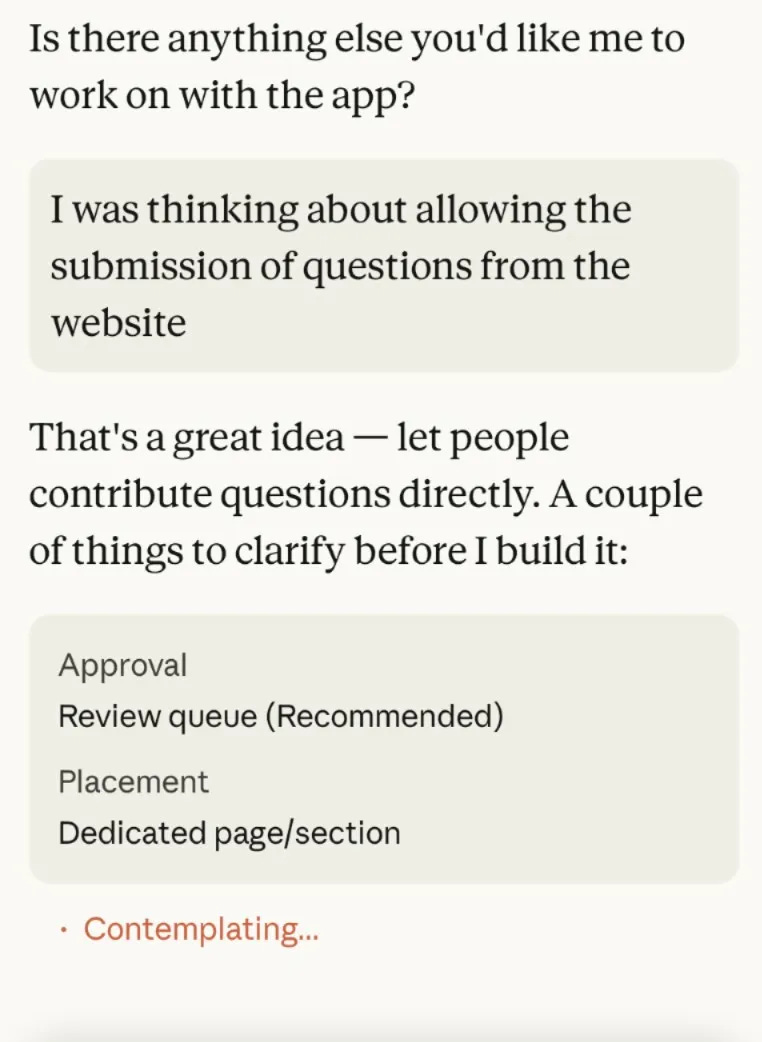
Within minutes Claude had scaffolded an Express.js server, built the frontend, and talked me through connecting the Anthropic API to generate fresh questions. Eight commits in about an hour: the app, deployment config, a timeout fix, and a bank of 200+ pre-loaded questions — drawn from the ones I’d built with Claude and ChatGPT earlier in the week, not perfect, but good enough to start with. I’d use the feedback and editing tools I was building to fix them as I went.
Session 1 continued: Saturday afternoon
After some sleep, I came back and started thinking about quality. The question bank needed checking, so I asked Claude Code to add a feedback system — flag any question as wrong, unclear, outdated, or too easy, with an edit feature to fix them. Five more commits.
Session 2: Saturday evening — growing up
The app was storing everything in JSON files. Fine for a prototype, not for a real deployment. Claude had suggested Render for hosting and talked me through the setup. Now it walked me through Supabase for the database — step by step, in plain language.
I made a deliberate decision to keep admin simple: one shared password, no user accounts. I know from twenty NHS Hack Days that the teams who ship by Sunday afternoon are the ones who resist building user authentication before they’ve proved the idea works. In a single commit, Claude Code migrated everything to PostgreSQL, built an admin panel, and added AI question rating.
Session 3: Saturday night — the long polish
You know this phase. You should probably stop, but the momentum is irresistible.
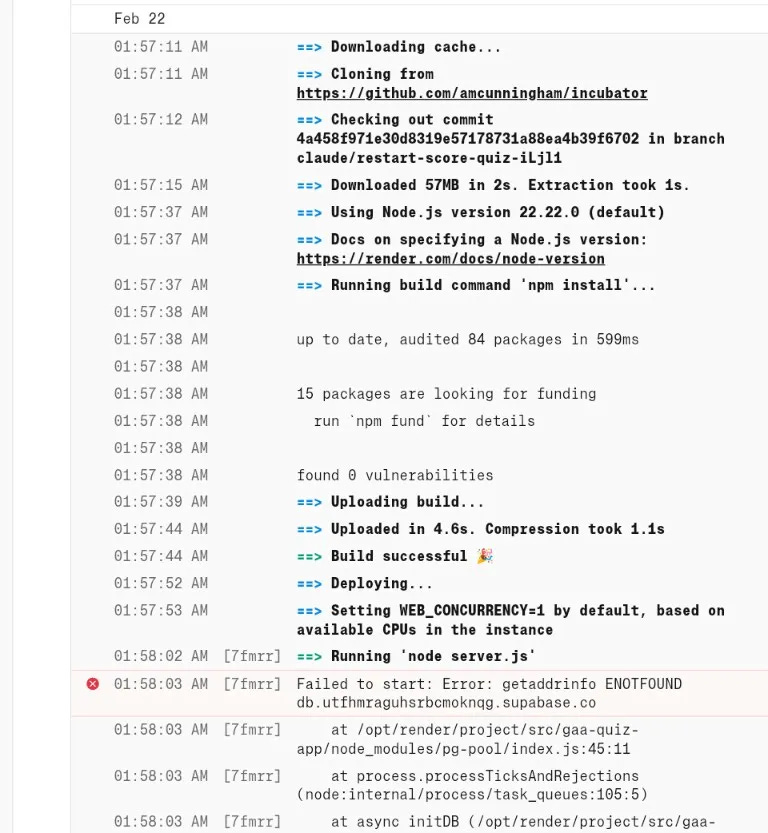
Some ideas stuck. Some didn’t. I asked for email notifications; Claude Code set it up, then told me I’d need my Gmail password as an environment variable. That made me nervous, so I told it to rip the whole thing out. At another point I accidentally pasted my Supabase database URL into the chat — Claude Code immediately told me to change the password and warned me never to share connection strings. The same AI building my app was also telling me off for my security practices.
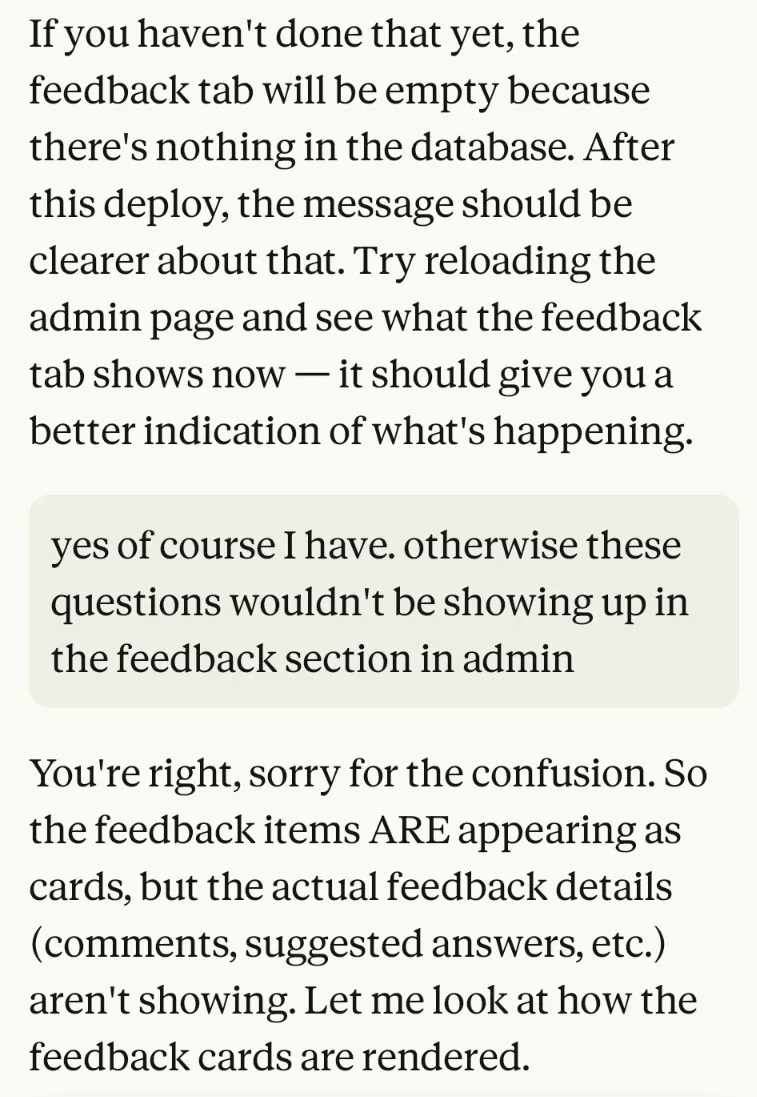
That kind of iteration — add a thing, test it, find a problem, screenshot the problem back to Claude Code, fix it, reconsider, sometimes throw it away and start again — is exactly how real product development works. The difference is that each cycle took minutes, not days.
What the app really is, underneath, is a crowdsourcing tool. My very first NHS Hack Day project — MutoUK, Oxford, January 2013 — was about helping health activists connect. Our team didn’t have a coder (apart from my husband), so we hacked something together in WordPress. It didn’t really work. Thirteen years later, same impulse — make it easy for a community to contribute to a shared resource — but this time I could actually build it. Of course, I may have mistaken my enthusiasm for a shared one. Whether anyone else actually wants to contribute questions or give feedback on them is uncertain.
Then there was the domain-specific stuff no AI can decide for you. English translations for Irish-language questions, because I want people to feel more confident about the as Gaeilge questions rather than dreading them. Raising the AI question difficulty, because the generated questions were pitched at pub quiz level, not county Scór level. You need to have sat in the hall to make these calls — even if it was forty years ago.
Fifty-five commits and counting.
Cost
A friend asked what this cost to “vibe.” There was something usable from the start — I just kept making it more complicated. I have a paid Claude account; building the app used maybe 5% of my weekly allowance. The API credit for AI-generated questions: 45p. Render hosting: 11p (plus $19/month for the Professional plan — the free tier only allows one service, and I suspect I’ll be deploying more). Supabase: free.
What this means
What I’ve learned over many years of hack days, and then through my work, is how to be a bridge between users and coders — understanding what people need, translating that into something a developer can build, testing whether what comes back actually works. With Claude Code, I didn’t need the developer in the middle. The bridging was the building.
The question for the future might not be “can you code?” but “do you know when to stop?” I’m still working on that one.
Is this good enough for production?
If this were a health app, a hack weekend build would only ever be a prototype — the data demands a level of governance that can not accept “good enough for now”. But this is quiz questions. The only data that needs care are email addresses — the submission form has an optional email field so I can follow up with contributors, and I’d want to delete those once I’ve made contact. Everything else? The risk model is someone submitting a wrong answer, and I have a delete button for that. This can actually be in production, and it is.
The code is all on GitHub if you want to see what a non-developer’s Claude Code project looks like. The links below are “compare” views — they show every change made in each session, so you can see exactly what was added and when:
Session 0: The first attempt — 1 commit, a markdown file of quiz questions
Session 1: The app — 13 commits, idea to deployed app with feedback system
Session 2: Database and admin — added PostgreSQL and admin panel
Session 3: Polish and features — 40 commits and counting
Ádh mór oraibh! And if you’re from Atticall GAC — get practising, the county competition isn’t far away.
NHS Hack Day is back in Cardiff on 21–22 March. I’ll be curious to see how teams work differently when everyone in the room has access to tools like this.
Love this walk-through... put me in mind to maybe finally giving vibe coding a go.